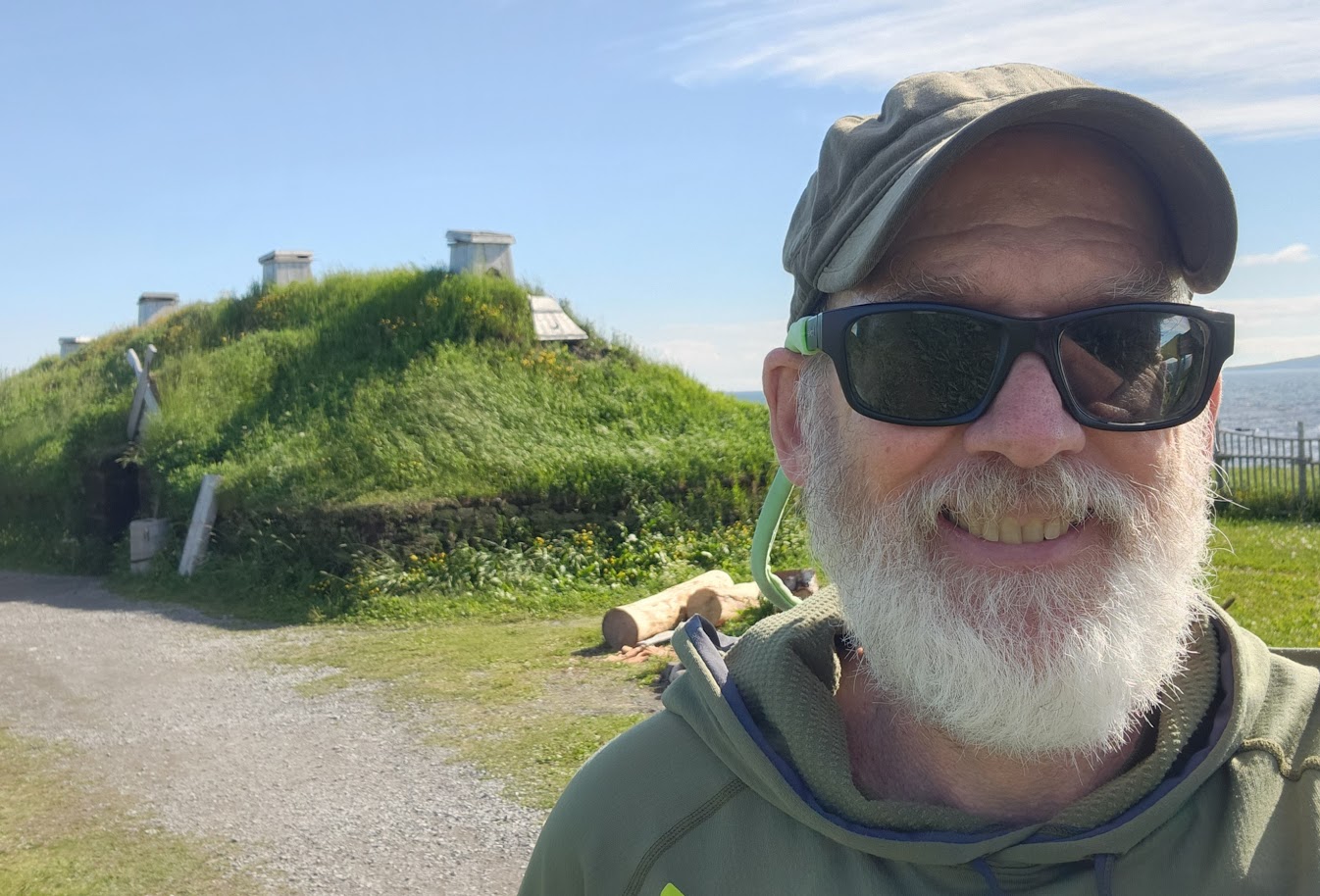
I plan to write at least two blogs on my impressions of the Parks Canada conservation, interpretation, and reconstruction of the Norse settlement at L’Anse aux Meadows. First, I’ll spin some sugar, and then I’ll throw in some spice.
In the interest of full disclosure, I love Parks Canada. The facilities are generally very well-kept, information tends to be clearly and cogently presented, and the folks tend to be über-Canadian-nice. A case in point: When I entered the Visitor Centre of L’Anse aux Meadows on Wednesday morning, I was greeted by a beefy and jovial young man who could have passed for Thor’s little brother. Seriously, regardless of what the comics or movies would have you believe, Thor is hulking, barrel-chested and red-haired, with a big bushy beard, and the flashing eyes worthy of a Thunder God. Look it up. Anyhoo, Thor’s young doppelgänger—let’s call him “Karl”—had chosen not to go all Gimli by braiding his beard, but clearly was considering it to offset what looked like a freshly shaved noggin (an attempt at disguise, perhaps?) When he charged us for our admission, I asked if I could buy a multi-day or weekly pass. “Why’d ya wanna do that?” he retorted, with an endearing slight confusion that reminded me of his older brother. “Because I’ll be coming back several times over the next few days; it’s OK if I have to buy a ticket each day….” “No, no, no!” He cut me off, although in my head I heard, “Nej, nej, nej!” “No need to do that. Just keep your ticket and show it when you come in.” That’s nice, of course, but that’s hardly the end of the story. Late Saturday afternoon the light was just glorious, so I decided to take one last jaunt down to capture a final image or two of the reconstructions at the settlement site. I’m staying just a couple of miles away, so I went on foot. I misjudged the time, however, and I arrived at the Visitor Centre just before closing time. The guy working the desk, in fact, was looking down at his phone as he called in a pick-up order for ten minutes later. Just beyond him, however, I saw Karl, so I made a bee-line to him, reminded him of our earlier conversation, and asked if I could run down and take a photo or two in this perfect light. “Sure ya can, but we’re locking up here, so you’ll have to go out the long path,” says he, poking a finger at a line on the park map clearly marked, “Restricted Access.” “Take yer time and take yer pictures.” “Oh, I can use that access to the main road?” I asked. “I thought it might be illegal….” “No, no, no…it’s fine….” He replied, as he waved me on my way. I went down, took my time, and got some beautiful shots. I followed the path he had indicated, which dumps out on the main road right by a set of car-charging stations. Electricity? Thunder God? Coincidence? You be the judge….
In any case, my point is that I am predisposed to have a very positive view of Parks Canada in general, and of this site and its staff in particular. Everything is well-explained and contextualized, the staff is welcoming and helpful, and they make it fairly clear that they have based their work on a relatively tiny sample of actual material evidence. That’s par for the course in the diaspora of North Atlantic Norse sites, however: Since we are not dealing with the tumbled-down ruins of large stone edifices (as often one might find in the Classical World, for instance), but rather with the low-mounded foot-prints of wooden-framed, turf-walled structures, archaeologists mainly have “post holes and midden heaps” left to analyze. That means that although they often can sketch out the outlines and interior partitions of buildings with great accuracy, the rest is much harder. Basically, since wood and turf have burned, rotted, sunken, and otherwise degraded over the past thousand years in wet, marshy conditions, archaeologists have to rely upon more fruitful finds from other digs, as well as written records to flesh out their knowledge. Added to that may be some insight gleaned from building practices that have abided with relatively few changes over time until recently in some traditional communities, for example, some outlying setlements in the Faroe Islands.
The reconstructions that sites like L’Anse aux Meadows build to help interpret the original settlement for the public are therefore the product of years of shifting evidence. In fact, one of the reenactors on-site this week discussed with John the current state of the shifting knowledge and general opinion about venting and smoke-holes in structures of this type. Over the coming few years, he added, the reconstructions at L’Anse aux Meadows would come to reflect these changes. There is also a severe paucity of material objects found in situ to inform us. This is not unusual either, however, because folks surviving on the very edge of their known world use and use and then repurpose tools—especially those of iron—until there is nothing worth saving. And people who move away take everything of value with them. Only what is left, or lost, or forgotten tends to remain for us to find on the trash pile or elsewhere around the living area. The remaining gaps are filled by best guesses, collating with information from other sources and sites. It’s a constantly evolving process, and it’s unrealistic to ask for perfection, at least until Mr. Peabody and My Boy Bret complete the Way-Back Machine so that we can go and check their work.
That all acknowledged, it’s fair to say that the scientists and staff at L’Anse aux Meadows have done very well with what little they have. Their interpretation tends to be engaging and even occasionally exciting, which is a crucial part of the job description of those of us who try to bring the past to life. The reconstructed buildings themselves are impressive, evocative, and to my mind fairly accurate in their attempt to portray Norse life in that time and place. The reenactors themselves are solid. They are not quite at the level of say, the trained craftspeople at Colonial Williamsburg in Virginia, or the shipwrights in the Boatyard of the Viking Ship Museum in Roskilde, Denmark, but the folks at L’Anse aux Meadows were entertaining, interesting, and thought-provoking, and I very much appreciated their dedication, knowledge, and welcoming spirit.
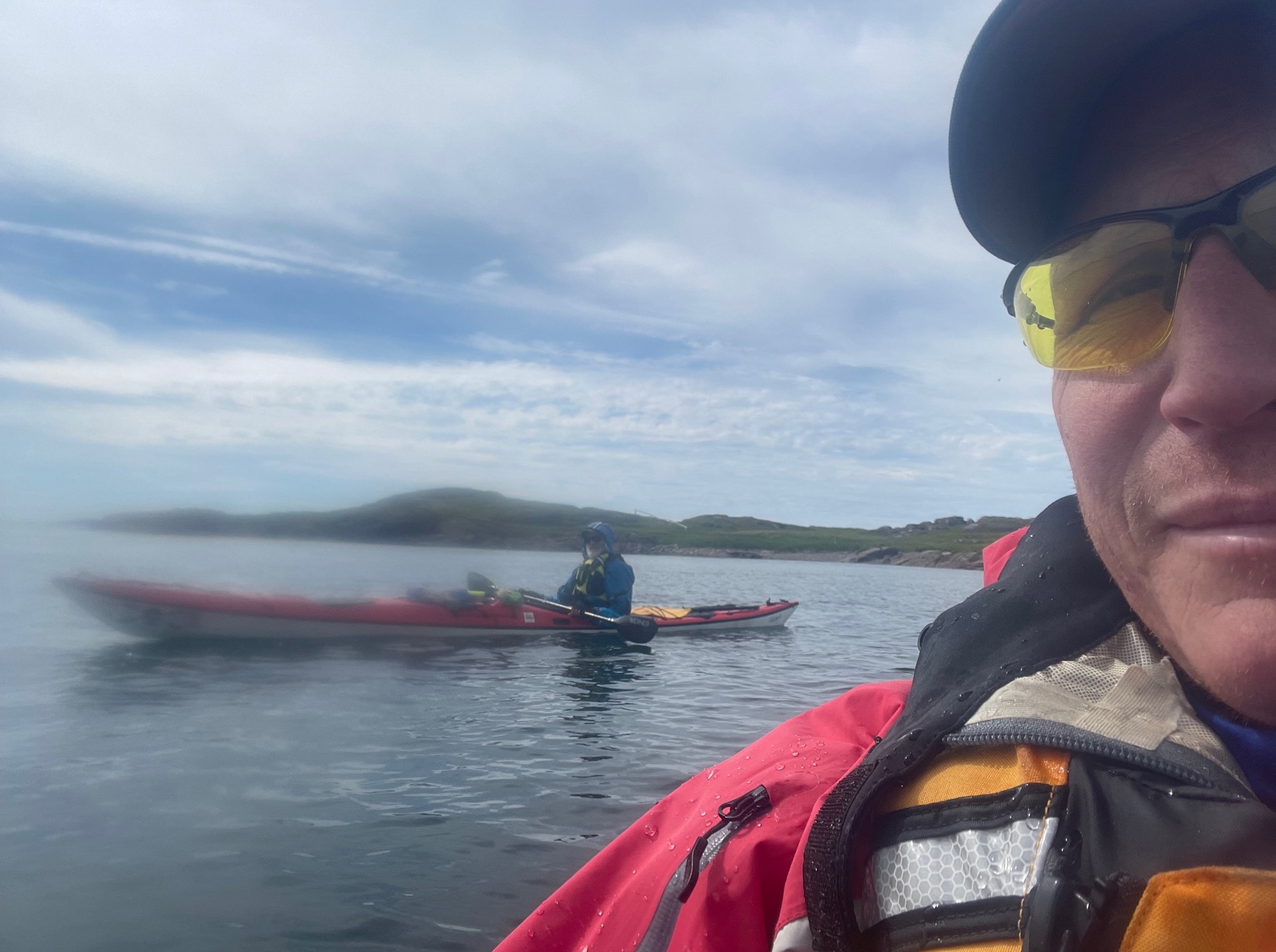
In short, both this paddler’s thumbs are up for visiting L’Anse aux Meadows. I’ll give a more nuanced criticism of some specific aspects of the interpretation of the site in a later blog.
Follow along on our ongoing adventures on this map:
https://share.garmin.com/IntheWakeoftheVikingsCFee
Keep up to date with our adventures and follow our movements through our blog:
 In the Wake of the Vikings