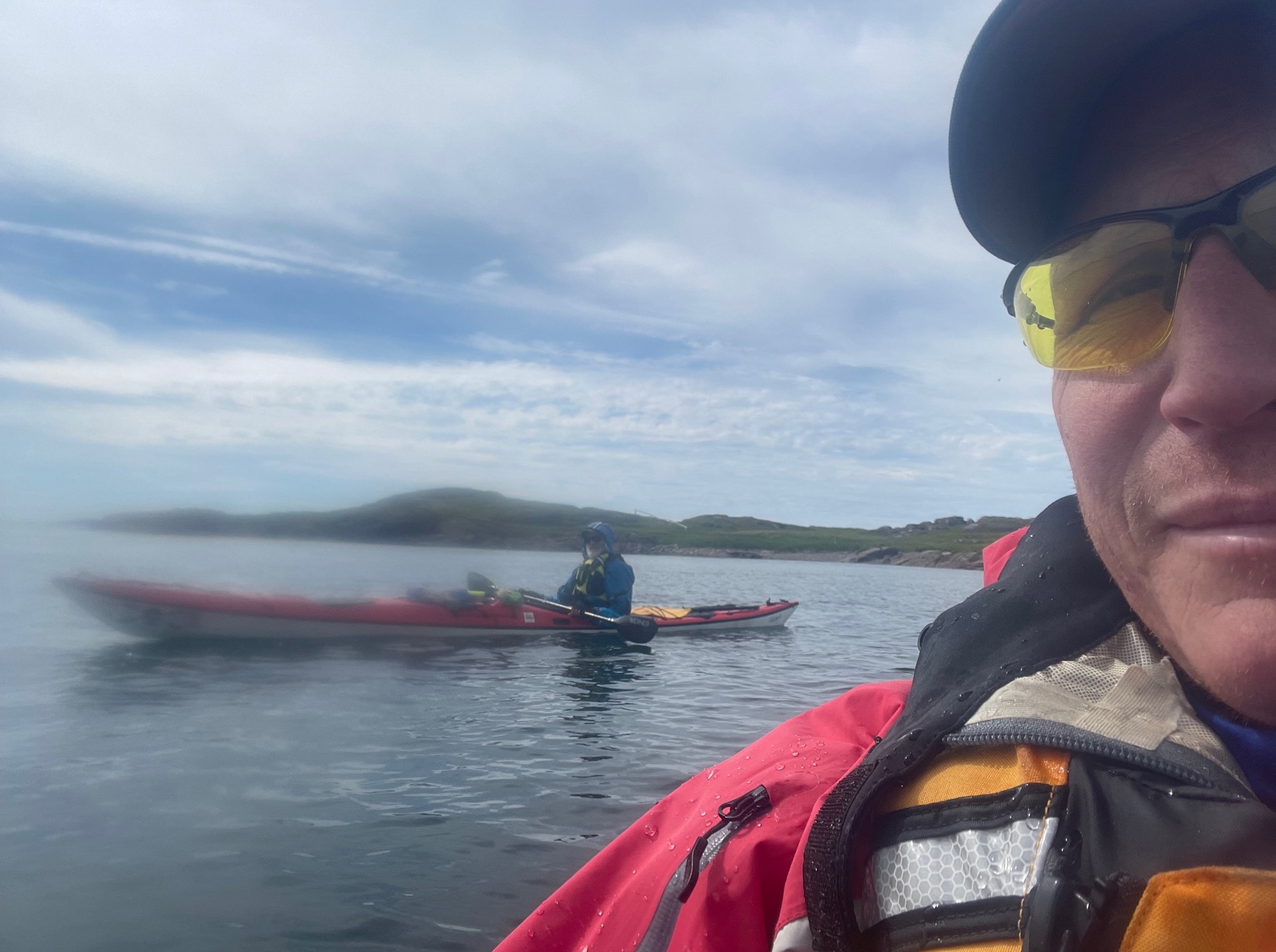
The plan for Sunday was to organize gear, wash laundry, shower, and then paddle later in the day. While Chris was taking care of his personal private business in the morning, I decided to walk to the shoreline, first, to assess the water and weather conditions and second—no, maybe first!—to get the heck away from the unforgiving blackflies. These little creatures are certainly dedicated professionals and perform their tradecraft with incredible tenacity. After a week on the Labrador Coast, I look like two of my adolescent worlds have crossed paths: I now resemble the unholy lovechild of chickenpox and acne. I am not wearing a baseball hat because I am having a bad hair day; I’m having a bad skin week, and I have regressed to my youthful insecurities that people will point, gawk, and make fun of my forehead. And the same goes with long pants. These legs are so not sexy anymore.
This is part of exploration; we speak excitedly about our interest in learning the stories and narratives of those we meet, and it turns out this blackfly narrative is a common theme up and down the coastline. On a side note, I learned not to say north and south when referring to the coast of South Labrador. A curt “we don’t use ‘north’ here,” from Ruby the Ranger—who dismissively eschewed netting herself—was enough to teach me this lesson.
Any expedition has a moment when the honeymoon is over; this is largely because, along with the excitement of pushing the edge comes the stark realities of nature and the environment at hand. Blackflies, these petite terrors, are a legendary part of the Labrador experience. Though we throw on bug netting and go into covered spaces, early inhabitants of the region had to deal with the consequences of insect menaces, which could cause sickness, disease, or at times, death.
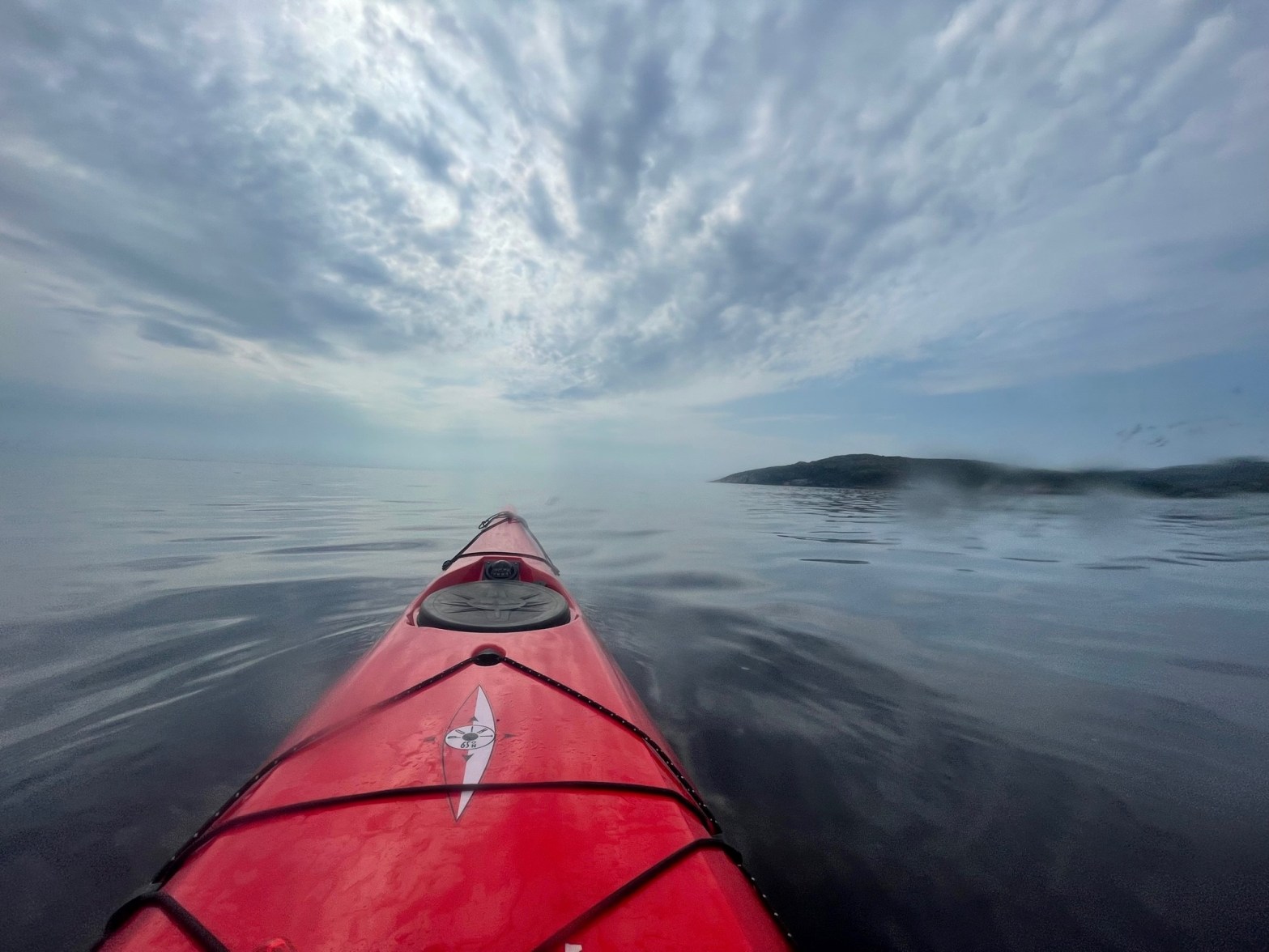
As the wind blew the cobwebs out of my brain and the blackflies off of my body, I suddenly realized that the water looked to be just about perfect for paddling right there and then. In Labrador, when the conditions are good, you go NOW. I called to mind the words of Trent O’Brien, the mayor of L’Anse Au Loup, that when the water appears placid it known as “flat, oily clam.” Sunday morning, the water looked “flat oily calm” from Labrador across the Strait of Belle Isle, all the way to Newfoundland. After Chris assisted me with launching my kayak, and resisting the powerful urge to jet directly across the Strait, I decided to go “down” the coast (not “south”) and then work my way back up the Pinware River. When I launched along the Pinware beach, five fishing boats were in the harbor. I steered clear for many reasons, mainly because all I am in the water is a speedbump if the captain of the vessel cannot see me against the light.
I then settled into a rhythm and soon lost myself in the Flow. Mihály Csíkszentmihályi, a Hungarian psychologist, is known for his research on the concept of Flow. It is the moment when one’s skill level aligns seamlessly with the challenge at hand, creating a sense of timelessness, happiness, full engagement, and the ability to participate in said experience as if on autopilot.
When there is not enough challenge in one’s life or in the activity at hand, one can simply become bored. If the challenge exceeds one’s skill, that experience can be anxiety-provoking, as noted by Csíkszentmihályi. The challenge was low when I first put my blade in the water, and the only thing on my mind other than being a momentary thud under the hull of a trawler, was how far out can these damn blackflies fly? Seriously, those tiny wings were impressive, though finally, I out-paddled them. It is common to ask, “what are you thinking about?’ while paddling with a partner, and what follows are moments of dialogue. In the case of solo paddling, for me, it is like ADD on steroids, and in part, that depends on where I am in my Flow state. If we were able to rewind the tape, it could sound something like:
“five boats, head for the point, com’ on blackflies get the, check the skies, look left, look right, I need to scratch my leg…oh, ok, good luck with that, how far, maybe the lighthouse, three coves, safe or too exposed, split the difference, Nigel and Russell, go more inland, I got…holy smokes that caught me off guard, lost the Flow, lighthouse, yes the lighthouse, jellyfish, no whales, come on whale…where are you, are my kids awake yet, can I get a selfie out here?”
And so on.
In short, the paddle was splendid. I set the initial course to cross over three coves to a small lighthouse (actually, a channel beacon) positioned on a rock cropping 150 meters offshore. I remained fairly close to the shore in case the weather became more dynamic, and also to see what the coastline had to offer. When I approached the lighthouse, the channel was more aggressive, with the swell ricocheting off the coast, then recoiling off the lighthouse rocks which turned into an unchoreographed dance. Nope, no more Flow state for me. I worked through the dance, trying to keep my grip relaxed, and my posture and form at ease. It was only for a few minutes, but enough to challenge some skills I had not used in a while. After I rounded the rock island and pointed my deck compass to 30 degrees, I decided to stay further off the coastline on my return. I realized I needed to dance a bit more, and doing so required me to stay outside the coves and my comfort zone. I kept a keen eye on the weather, the fog off in the distance, and the swells around me. The wind was to my back, the seas thrust me in the direction of my heading. I held the edge of the kayak as I turned into the river’s mouth and caught the incoming tide into the Pinware River basin, back to flat oily calm.
Follow along on our ongoing adventures in ten-minute intervals via this link:


👍❤️
LikeLike