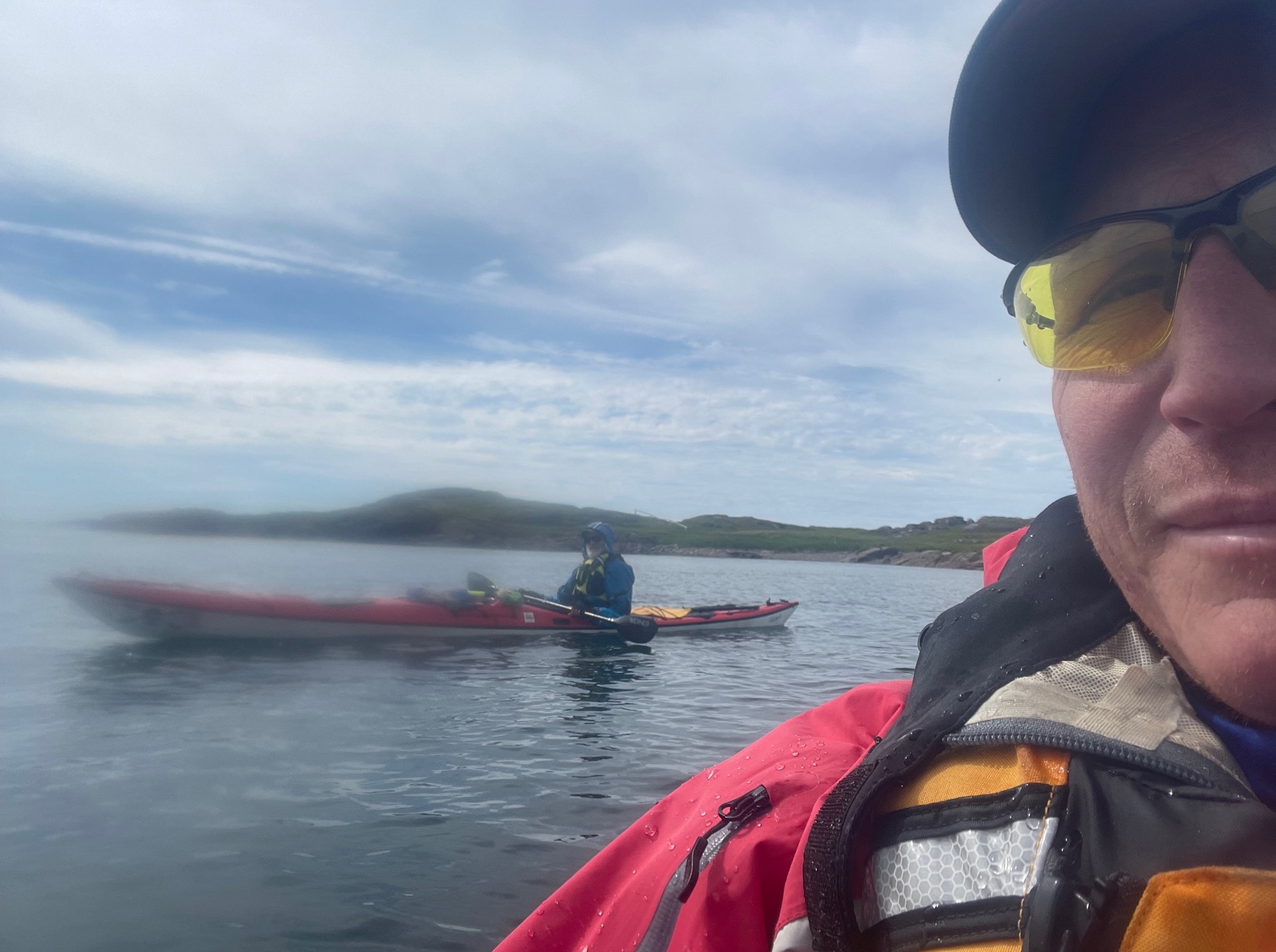

On the day that John and I paddled to L’Anse aux Meadows to view and to visit the Norse settlement site for the first time from the sea, we returned to pull out at a boat launch only a few yards from the feet of a statue of Leif Eiríksson. The son of Eirík the Red, Eiríksson is remembered to posterity as “Leif the Lucky.” Landing so close to him was auspicious for a number of reasons, and so after we had pulled off our dry-suits and loaded our gear and boats, we wandered over to have a little visit. Thereafter, I made it a practice to take daily walks down past the settlement site to take a few moments with Leif. I tried to spend as much time as possible wandering several miles a day afoot along the coast in the vicinity, getting a feel for the landscape just as I have for the seascape. I visited at various times of day and in several distinct types of weather, just to try to experience what this place might have been like when Leif and the others trod these paths. As I did so, my thoughts often turned to the saga accounts of Leif. Since he has long been thought to have led the first European settlers to this site, Leif casts quite a long shadow, and in our book, John and I use him as a case study regarding Norse notions of leadership.
A good place to begin to understand why Leif would be a good choice in this regard is with the origin of his nickname. We learn in Chapter 4 of Grænlendinga Saga that, having rescued 15 men shipwrecked upon a rock, Leifr Eiríksson, var síðan kallaður Leifur hinn heppni, “was thereafter called Leif the Lucky.” Although this by-name is widely known to us and may seem almost clichéd, it actually describes perhaps the most important feature and admired trait of leadership during the Viking Age and throughout the Norse period of expansion, exploration, and colonization. Luck, like boldness, navigational skills, seamanship, and generosity, was a fundamental attribute—and in a certain sense a prerequisite—of a successful leader in the Norse world, whether that be as a battle chief, as a goði or headman in a local or regional Icelandic assembly, as a merchant skipper, or as a leader on a Viking raid. Successful leadership throughout the Norse sphere of colonization during and after the Viking Age was measured by a number of factors. These included physical abilities, martial prowess, necessary knowledge, required skill sets, and technical experience, not to mention proven performance.
Perhaps the two most important factors, however, would have been reputation and luck, which we understand only in part if we take these modern English terms to be the precise equivalents of their Norse counterparts. Reputation in the ancient Germanic world (of which the Norse are the northernmost subset) in many ways comprised all of the aforementioned aspects of experience and proven performance. Added to these, however, are crucial intangibles that are harder to quantify, including honor and integrity and the general tenor of that person’s relationships and interactions with others that we might put down to the “vibe,” or overall demeanor, of a person. Likewise, “luck” in this context means much, much more than generally having the dice fall one’s way more often than not: People and objects and places might be thought to be imbued with good fortune in a way that had tangible and quantifiable results for and impacts upon those who came into their orbit. Moreover, as you can judge for yourself if you choose to read our book, we mount what we believe to be a persuasive argument that there are clear parallels between Norse and modern notions of luck and its relationship to success, and that this has an impact upon how we perceive and quantify leadership abilities. This is certainly the case in expeditionary endeavors such as sea-kayaking and mountaineering. One of the points we raise is that adventure-based activities both test and develop not just the technical skills and leadership abilities of the individuals involved, but also the aura of experience, competency, and—yes—luck associated with them. This is another reason we have chosen to travel In the Wake of the Vikings as we have: the daily thrills, terrors, challenges, and opportunities we have faced, the excitement, the boredom, the unusual, and the mundane, all of these are part and parcel of both sea-faring and surviving in this region of the world. Tasting a little of it may give us some small insight—however slight—into some of the quotidian realities of the Norse facing similar elemental realities. In any case, they certainly give us ample discernment concerning our own abilities, qualities, and limitations, which is extremely useful in defining and understanding intangible aspects like “luck” and “leadership.”
We have plotted many of our adventures on this map:
 In the Wake of the Vikings
Can’t wait to read the new book!
LikeLike
Thanks!
LikeLike