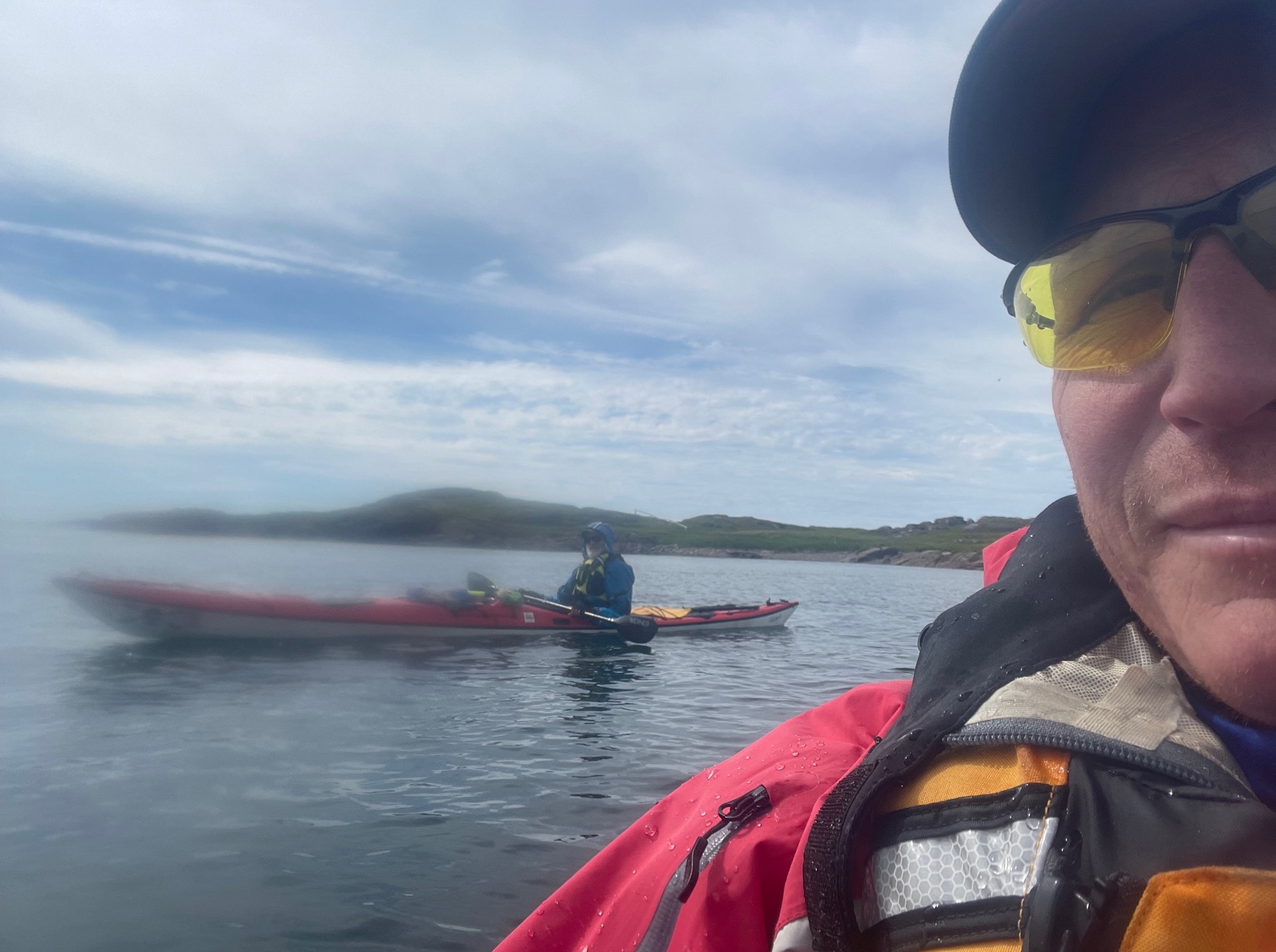

Late one afternoon, after we had pulled out of the water at Pinware River Provincial Park on the South Coast of Labrador, I had an interesting exchange with a friendly traveler interested in our attempt to paddle In the Wake of the Vikings. You see, he was doing something similar himself, although in some ways our experiences could not have been more different.
His name was Jens, and he was from Germany. He was one of several people we encountered who were touring all through the most remote and inhospitable regions of Labrador, anywhere vaguely connected by anything remotely like a “road,” in large, almost armored-looking, all-terrain RVs.
We discussed the research agenda of Team Viking, and then something else that we had in common with him: Although his was a very heavy rig and ours was ultralight, we both carried with us everything we needed to survive and even to be comfortable off-grid. We both had our own water supplies, filters, power, and heat, and everything else we needed. In a weird sort of way, we were opposite sides of the same coin, and we both stood out in every park or campground we entered. People were always approaching both of us to discuss our rigs. He politely asked about our experiences and equipment, and I reciprocated.
“Tell me,” I said, as our conversation moved onwards, “what do you call that type of vehicle?”
“I don’t know, exactly,” he responded. “I suppose that some people call them, ‘Overlanders.’”
I had seen such rigs before, and had researched them a little, simply out of curiosity. Champagne tastes but a mead budget, you understand. I’d never spoken to an owner of one before, however.
On the basis of my casual knowledge, the rig Jens was driving looked like a Unimog to me. Built in collaboration with Bavarian Ziegler Adventure, Daimler Truck refers to these beasts, the Flagship Off-Road Luxury Survivalist Overlander RVs of the Mercedes-Benz line, as the “‘MOG HOME’ FOR MODERN ADVENTURERS.” The Unimog is a rugged truck chassis produced by Daimler, the parent company of Mercedes-Benz. The classic conversion into an RV was built on a foundation originally produced as a military ambulance all-terrain vehicle model suitable for the most primitive off-road conditions. Eye-balling his rig, I’d estimate that Jens was driving something vintage in the range of the classic 1985 version of the Unimog Camper. It’s a thing of beauty, in its way, sort of like a classic Land Rover on steroids. Used and in good condition, these run something along the lines of a cool quarter million. New conversions seem to run anywhere from several hundred thousand to a million. Dollars. American Dollars. Just to be sure that we’re all on the same page.
“I notice that it has German plates” I continued, “did you have it shipped here?”
“No, not exactly: I came with it. There’s a boat you can take. Sort of like the Roll-On, Roll-Off (RORO) ferries you take to and from Newfoundland, only bigger. We sailed from Hamburg to Halifax. You can sail to a few ports in the US, too. You could ship the vehicle, but you can also travel with it, and have a cabin on board for the journey. Takes a couple of weeks. Just like the Vikings, eh? I recommend it.”
All that brings me back to my original point about Jens and his journey, and how that relates to his joke of being like a later-day Viking. He had, after all, sailed out from Hamburg, at the very base of the Jutland peninsula, out the Elbe River to the North Sea, and thence across the Atlantic, landing at Halifax, Nova Scotia, which could well have been within the pale of the Norse conception of “Vinland.” From there, he climbed into his giant, seemingly impenetrable, vague military-looking vehicle and began to explore the coast of Newfoundland and Labrador, much as the Norse had. Hamburg historically was cheek-by-jowl with Denmark, until the Second Schleswig War in 1864, after which Denmark lost control of most of the southern portion of Jutland. Vikings even had raided the city in the ninth century, and it was also occupied briefly by Danes in the early thirteenth. In any case, the region around the Elbe traditionally was the northern continental European frontier with what we traditionally think of as the “Viking” or “Norse” world.
I was reflecting on all this even as we spoke. Rousing myself, however, I noted that it was past time to move on and to get dinner started. We laughed, shook hands, and parted ways.
I wish him well.
I must also acknowledge that, although I certainly don’t really want his vehicle, I very much envy Jens his journey across the ocean, which would have complemented our own very nicely.
We have plotted many of our adventures on this map:
https://share.garmin.com/IntheWakeoftheVikingsCFee
Please note, in particular, that the company emphasizes: “It is possible to sail with your vehicle from Europe to North America on the same RORO ship. The prices include full board.”
 In the Wake of the Vikings
That is quite a vehicle–not my cup of tea, either, though I can’t help admiring it for being what it is so…successfully. To pursue your parallels a bit more, I can’t help wondering if the Vikings’ transport would have been–in it’s day–more in line with Jens’ or your chosen tools.
LikeLiked by 1 person